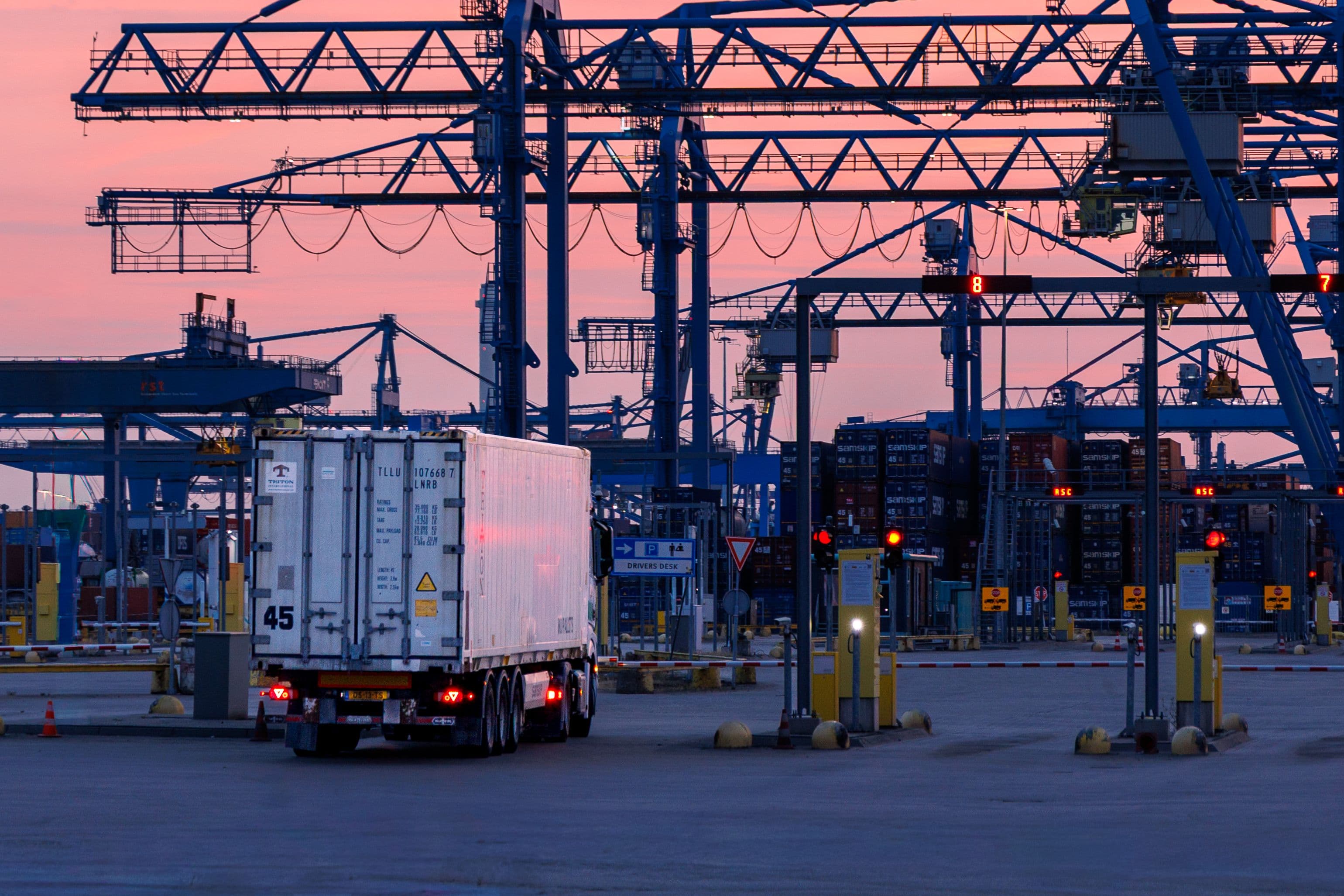
Across its first port deployments, Relai has measurably cut idle time and emissions by coordinating vessel, terminal, yard, and truck on a single real-time system.
Idle time is the freight supply chain's quietest cost. Trucks wait for containers that aren't ready; containers wait for trucks that aren't scheduled; and every hour of waiting burns fuel and capacity. By giving each party a shared, real-time view of what's happening next, Relai lets moves be sequenced instead of stalled.
The problem has always been less about any single delay than about the compounding of many small ones. A vessel discharges an hour behind schedule; the yard re-plans; the appointment no longer matches the work; the trucker arrives to a box that isn't staged; and by the end of the day the queue at the gate is an hour long and nobody can say exactly why. Each link acted rationally on the information it had. The information was simply out of date the moment it was shared.
Relai attacks that decay at the source. Rather than passing status between systems in batches, an email here, a portal refresh there, it maintains one live picture that every party reads from and writes to continuously. When a vessel's discharge slips, the yard plan, the appointment, and the trucker's assignment all see the change at once, and the network re-sequences before the delay has a chance to compound.
Early results from partner terminals show meaningful reductions in gate turn times and truck idling, with a corresponding drop in emissions from engines that would otherwise be running in a queue. The emissions savings are not a separate initiative bolted onto the platform; they are a direct consequence of fewer trucks spending fewer hours idling for containers that weren't ready.
The effect is most visible at the drayage handoff, historically the least coordinated link in the chain. When a driver knows before leaving the yard that a container is staged and the appointment holds, the trip is a single clean move instead of a speculative run that ends in a wait. Multiplied across thousands of moves a week, the difference in fuel, hours, and driver frustration is substantial.
The deployments follow the real-time coordination approach Relai validated in its end-to-end handoff pilot with a leading carrier, which tracked a single container across every stage of a port call on one live timeline. What began as a controlled test has become the default way these sites now operate.
Operators have also found that the same data that reduces idling makes the environmental gains easy to prove. Because every move is timestamped on a shared record, a terminal can point to exactly how many idling-hours were avoided and translate them into fuel and emissions saved, turning a soft sustainability claim into a number that stands up to scrutiny.
Relai is now extending the same instrumentation to additional gateways, turning idle-time reduction from a one-site result into a repeatable outcome. That expansion leans on deeper integration work and the analytics that make the savings legible across every lane, so each new site can point to exactly where the hours and the fuel were saved.